Magic, Miracle, and Rational Explanation
Felix AustriaMagic, miracles, and rational explanation form a tension between what can be exposed as a trick and what remains powerful even when no supernatural cause is established. Stefania approaches illusion as a puzzle to solve: the modern world has made wonders more visible and more explicable, yet the desire for wonder persists. At Ernest Thorn’s performance, she offers a material explanation for his apparently impossible entrance; later, thinking of Thorn while watching Père Josef, she imagines a power that acts not on objects alone but on feeling and perception.
A modern world that explains its wonders
Stefania’s curiosity about magic and sorcery goes back to childhood. She is drawn to what she calls the dark knots of the world, wanting to plunge into them and find answers. That appetite belongs to an age in which, as she sees it, almost no secret remains secure. Her reflections place technological change alongside the diminishing authority of older explanations: automobiles travel the roads, the railway station has electric lighting that still fails, moving pictures have followed photographic displays, telephones carry voices across distance, and Röntgen rays see into the human body. Even particles seem to divide and move everywhere. These advances make the marvelous appear less like a supernatural exception and more like an effect waiting to be explained.
The same confidence reaches into medicine and folk belief. Stefania rejects the notion that knots in hair are caused by preparing and eating fish in a Jewish manner, or that they have a sex and become fatal as soon as they are cut. She also notes that bloodletting does not cure and can be harmful. Such examples make rational explanation more than an abstract principle: it can unsettle inherited beliefs and expose practices that cause harm. Yet Stefania’s confidence has a provocative edge. She imagines that, if scientific progress continues at its present pace, physics may eventually explain God. In an earlier age, she reflects, such words might have led to her execution as the city’s second witch.
Thorn’s illusion and the visible mechanism
Stefania persuades Adèle, with difficulty, to take her to the performance of the famous illusionist Ernest Thorn. She is not a credulous spectator. Although she is fascinated by marvels, she assumes that Thorn’s feats are carefully devised tricks, with their key somewhere in plain sight. This distinction lets her enjoy the spectacle without surrendering her desire to understand it: wonder is welcome, but it need not be mistaken for proof of the supernatural.
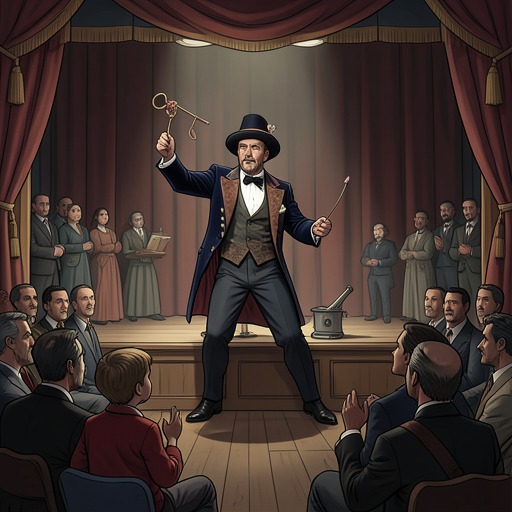
The performance begins with an entrance that appears to have no physical cause. After a tense wait and a moment when some spectators leave or consider demanding their money back, the audience’s attention turns to the stage. Thorn is already standing before a blue-and-red Chinese pagoda, seemingly conjured from empty air. No one sees him emerge from behind the curtain, separate from the scenery, or step out of the shadows. The spectators are certain he was there from the instant the curtains opened, and their bafflement is intensified by the absence of any visible movement. The scene makes the central problem perceptual as much as mechanical: if the trick happened before everyone’s eyes, why did no one see it?
Stefania answers Adèle and Petro by pointing to the cloth draped over Thorn’s arm. She believes it covered him from head to foot; its other side, patterned blue and red like the pagoda, could merge with the scenery. She remembers seeing the silk shroud slide away, as if the last, thinnest layer had been pulled from the air. The explanation depends not on secret supernatural powers but on attention to an ordinary object and the audience’s readiness to overlook what is in front of it. For Stefania, dispelling an illusion requires recognizing honestly what is actually seen. Petro smiles in complicity, while Adèle shakes her head: Adèle wants to believe in miracles, and Stefania’s explanation does not persuade her to abandon that wish.
Thorn’s subsequent handling of an empty-looking chest extends the performance’s play between proof and deception. He removes a succession of brightly colored garments and accessories, displays each item, and piles them on the floor. He then turns the chest upside down and shakes it to show that its red-satin interior holds nothing but a few balls of string. The deliberate display of contents and emptiness invites scrutiny, but it does not make the performance cease to be an illusion. Instead, the trick relies on the spectator’s uncertainty about what a demonstration has and has not established.
Performance, theft, and suspicion
The question of rational explanation acquires practical stakes when Père Josef and Petro discuss the recent increase in disappearances of valuables and religious relics from places of worship. Petro suggests that the simplest answer might be that the clergy themselves are responsible; the priest receives the suggestion without taking offense. He offers another possible connection: the thefts in a given city may coincide with Ernest Thorn’s performances there. The idea links theatrical deception to a series of real losses, without yet proving that Thorn is responsible.
Stefania knows that her own enthusiasm for Thorn could become relevant to the discussion: she has attended his performances faithfully. Petro glances at her, and she expects him to tell Père Josef that she is an ardent admirer, but he stays silent. The moment places her private fascination beside a possible investigation and leaves the explanation unresolved. The same skill that makes Thorn’s stage tricks entertaining—controlling what observers notice—could be relevant to theft, but the conversation supplies suspicion rather than a demonstrated solution.
A different kind of power
When Stefania watches Père Josef, her thoughts return to Thorn’s magic, but the comparison marks a difference rather than simply classifying the priest as another illusionist. She imagines that he possesses something strong and divine: a magical force able to dissolve solid objects into air and make feelings and glances material and tangible. She then decides that what he has is more powerful still, something beyond the human. Her language reaches toward the supernatural, but the evidence does not establish whether Père Josef literally performs miracles. The force she describes is presented through Stefania’s perception of him, not through a verified demonstration.
That uncertainty complicates the opposition between reason and belief. Thorn’s entrance can be explained through camouflage, and Stefania is willing to look for the mechanism. Père Josef’s power, by contrast, is figured as an ability to transform the meaning of objects and make invisible attachments felt. The distinction is not simply between a false trick and a confirmed miracle: the novel shows Stefania moving from confidence in explanation toward an experience she cannot settle in the same way. Her final thought—that she may have known this person before—adds recognition and mystery to the encounter without resolving its cause.
The function of wonder
The contrast between Thorn and Père Josef gives wonder two different forms. The stage illusion is constructed to be seen and misread; its apparent impossibility invites the audience to search for a concealed mechanism. Stefania’s explanation restores agency to the attentive observer, while Adèle’s continued desire to believe shows that knowledge and enchantment need not coincide. The audience can be amazed even when a plausible trick is available, because seeing and understanding are not the same act.
The religious thefts widen this tension beyond entertainment. In the discussion between Petro and Père Josef, the question of who removes sacred objects remains open, and Thorn’s touring performances become a possible clue rather than a supernatural cause or a proven crime. Meanwhile, Stefania’s response to Père Josef makes room for a kind of magic that operates in emotional and relational perception. The novel does not resolve every uncertainty by choosing either rational explanation or miracle; instead, it distinguishes the tricks that attentive observation may expose from experiences whose significance cannot be reduced to a visible mechanism.